 Travel Voice | Japanese Travel Trade News Japan's No.1
EY Strategy and Consulting released the survey report on a dual-residence trend in Japan, targeting about 10,000 18 to 69 years old nationwide. to analyze processes from travel to dual-residence or emigration.
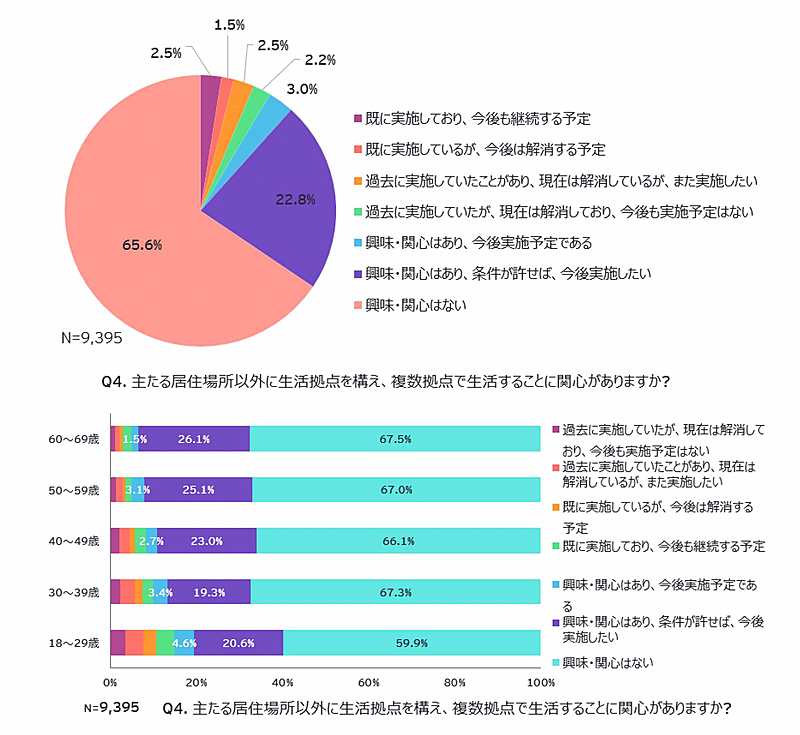
The survey results find that 25.8% were interested in dual-residence in Japan, and 8.7% have already experienced dual-residence. EY said that the dual-residence market is not small as about 30% were interested in the lifestyle.
The interest was higher among people with high annual incomes than others. More experiences were found in 18 to 29 years old, and also ratio of ‘planning dual-residence in the future’ was 4.6%, higher in the age segment than others.
 報道資料より
The top reason to select a dual-residence destination was ‘I liked it as a travel destination’ with 42.5%, followed by ‘I have been there several times before’ with 19.0%.
Tomotaka Hirayabashi, Partner, Strategic Impact, EY Strategy and Consulting, said, “Tourism experiences contribute to attachment to the region, which tends to lead to an intention to settle there. Therefore, coordination between tourism policies and measures to promote settlement is required.”
35.2% answered that they prioritize ‘relaxing environment’ for dual-residence. Interestingly, 17.3% answered that they select a dual-residence destination within 90 minutes from home, and the trend was higher with 23.4% in 18 to 29 years old.
The survey results also show that young people preferred to stay longer in a dual-residence destination, as 33.2% of 18 to 29 years old stay in a dual-residence destination for 25 to 50% of their daily lives.
From dual-life to emigration or settlement
6.3% of d dual-residence experiencers ‘have already changed residence certificate or plans to change it,’ and 39% answered that they were considering it. Among 18 to 29 years old, 12.0% ‘have ‘already changed residence certificate or plans to change it,’
About 30% were interested in emigration or settlement. In the same manner of dual-life, the interests were higher among people with high annual incomes and among young people. Interestingly, about 10% answered that emigration or settlement depends on lives after retirements or growth of children.
EY also surveyed remote work, which is becoming increasingly important in dual-residence. The results revealed that only 10% of people are able to work remotely from their travel destinations and travel freely without being tied to calendared holidays. Hirabayashi stated, "As companies become more understanding and improve their environments, there is potential for greater flexibility in work styles and for tourism-driven connections to local communities to deepen. In addition to improving Wi-Fi and co-working spaces, creating ‘spaces’ within local communities is also required.”
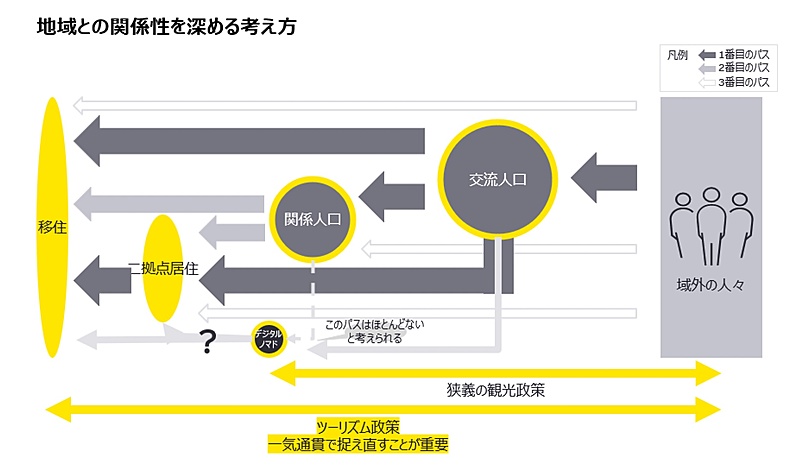
Seamless strategy from tourism
Analyzing the survey results, “For the majority of people, dual-residence is on an extension of travel. However, different target demographics have different needs. The effectiveness of policies will depend on the detailed target setting,” Hirabayashi points out. “Local governments should consider dual-residence as part of tourism policy and implement policies in a unified manner."
 報道資料より