 Travel Voice | Japanese Travel Trade News Japan's No.1
At ‘HOTERES EXPO Tokyo 2026,’ Kazuyoshi Shimojima, Polaris Holdings COO, and Rei Matsuda, Koko Global Hospitality (Thailand) CEO talked about how stay-oriented hotels can win in the future, moderated by Terunobu Kuribayashi, JTB Tourism Research & Consulting senior researcher.
Japan itself is a brand
Before the discussion, Kuribayashi explained the recent market trends in Japan. He presented data that average daily rates (ADR) for hotels in Tokyo and Osaka rose by 20–45% compared to 2019, and revenue per available room (RevPAR) in major cities increased by 25–50%, while room occupancy rates themselves remain between 70% and 85%—showing virtually no change from 2019.
He said, “The current domestic market is being strongly driven by a genuine rise in room rates. Form supply side’s perspective, a notable trend is the growth of lifestyle-oriented hotels.”
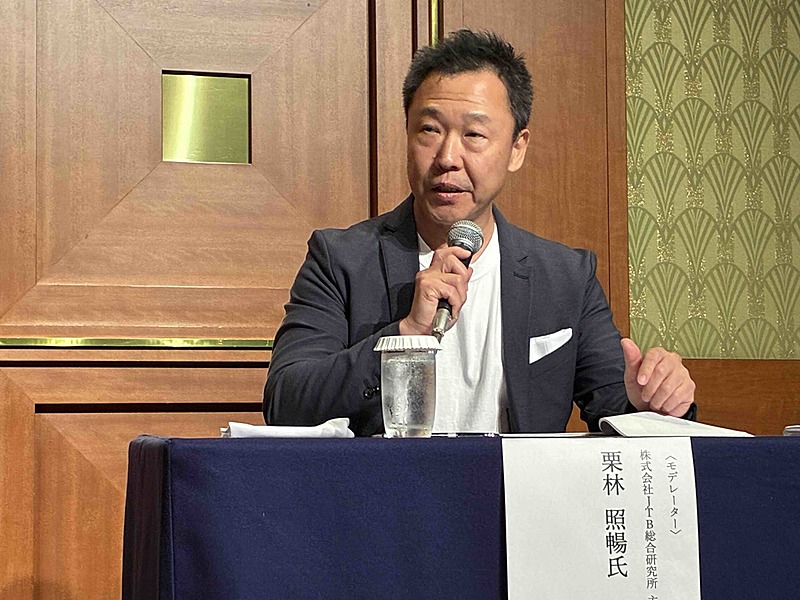 Terunobu Kuribayashi, JTB Tourism Research & Consulting senior researcher.
Under the market circumstances, Polaris and Koko Global Hospitality referred to their own business strengths. Polaris Shimojima said, “The cleanliness, operational precision and meticulous service standards, for which Japanese hotels are renowned, provide an overwhelming competitive advantage over international rivals. These qualities underpin the exceptionally high repeat-visit rate among inbound tourists.”
Establishing in Thailand in 2015 and operating 32 hotels in Thailand, Koko Global Hospitality Matsuda emphasized ‘Japanese’ as a value in overseas markets. “In Southeast Asia, the fact that a business is Japanese-owned serves as a powerful brand asset, fostering trust among owners and employees alike. In addition, operational expertises in Japan and operational quality standards of Japan become a potent competitive weapon in foreign countries.”
Unification of operational platforms and establishment of the brands
Both Shinojima and Matsuda pointed out Unification of operational platforms and establishment of the brands as business priorities.
Shimojima said, “The first step is to build a unified operational platform over different brand hotels under Polaris. Only by organizing data in a standardized format, we enable future AI integration and advanced data analysis.”
For effectiveness of operation, streamlining operations carries the risk of homogenizing services and facilities, potentially leading to commoditization and a loss of differentiation from competitors. Shimojima, however, introduced that Polaris advances ‘Fell the Local’ program showing local features in a hotel.
“The perpetual challenge lies in creating a brand that offers a cohesive experience to guests while keeping owner investment to a minimum,” Matsuda said. “We see Starbucks, which maintains a consistent tone across locations regardless of store size, as the primary model for us.”
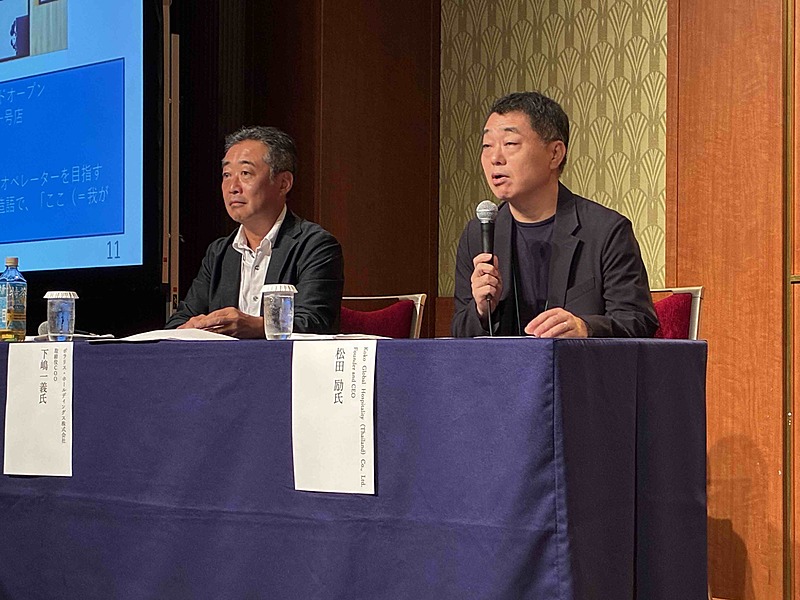 Polaris Shimojima (left) and Koko Global Hospitality Matsuda
No employee satisfaction, no customer satisfaction
Employee satisfaction (ES) is a very important for business continuity. Shimojima emphasized, “It is important for us to properly acknowledge, give shape to, and commend the ideas generated by each store.”
Matsuda said, “Communication from the president to managers and from managers to employees naturally shapes how employees interact with guests.”
Value-added digital transformation
They talked about digital transformation for hotel operation as well. Shimojima said, “Rather than simply digitizing current operations, the need to redesign them by working backward from a future where AI is a given,” citing guest room design as an example. Also, he added, “It is very important to incorporate detailed text information in a hotel website or word-of-mouths for AI search engine to find the hotel.”
“AI-driven analysis and strategy formulation are beginning to outperform human thinking,” Matsuda said. “However, all existing SaaS tools will be replaced by AI. Instead, a hybrid model combining existing SaaS with in-house AI is likely to continue for some time."