 Travel Voice | Japanese Travel Trade News Japan's No.1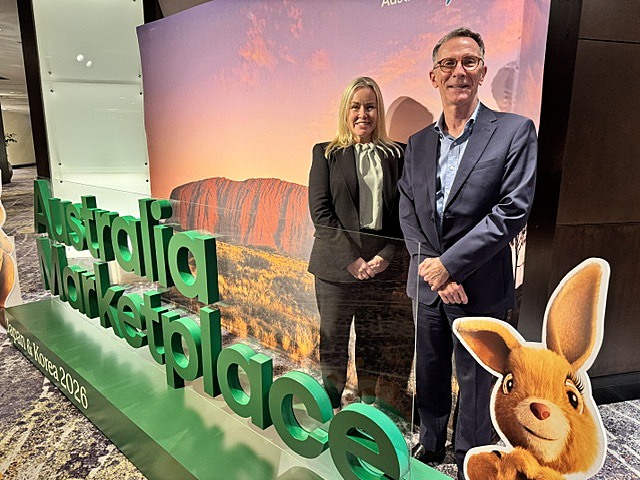
Tourism Australia (TA) held the ‘Australia Marketplace Japan & Korea 2026’ B2B trade event in Tokyo. The event saw participation from 63 sellers from Australia and a combined total of 66 buyer companies and divisions from Japan and South Korea, resulting in over 4,200 business meetings. Participants from Japan included 49 buyers representing 39 companies and divisions.
Catherine O'Brien, Executive General Manager of Global Markets at TA described the event as a "crucial B2B platform for strengthening relationships with key Japanese partners." She also said that Japanese travel agencies show their strong determination to further accelerate growth that is already becoming apparent.
Australia saw a 12.7% increase in Japanese visitors
According to Derek Baines, Regional General Manager for Japan and Korea the number of Japanese visitors for the year ending June 2026 reached 447,600, a 12.7% increase year-on-year. Tourism expenditure for the year ending March 2026 totaled AUD 2.3 billion (approximately JPY 262.2 billion), up 10% from the previous year. While the impact of the weak yen persists, TA reports a particularly strong recovery in travel among women in their twenties.
O'Brien highlighted big international sports events, such as the 2032 Brisbane Olympic and Paralympic Games and he Rugby World Cup in 2027, will be huge opportunities to boost travel demands and encourage international travelers to tour to local regions. A joint promotion with JTB has already been launched in connection with the Rugby World Cup.
TA has indicated the potential for the number of Japanese visitors to rise to 680,000 by 2029. In light of these trends, Baines said, "if we can sustain growth of around 40% over four years, an annual average of about 10%, I believe reaching the 680,000 mark is possible.”
In addition to ‘Come and Say G’day,’ the global branding campaign for consumers, TA is strengthening joint promotional activities with major travel agencies and the "Aussie Specialist Program" (ASP) for travel agents, as well as joint efforts to gain ‘High Yield Travelers (HYT)’ for the tourism industry of Japan.
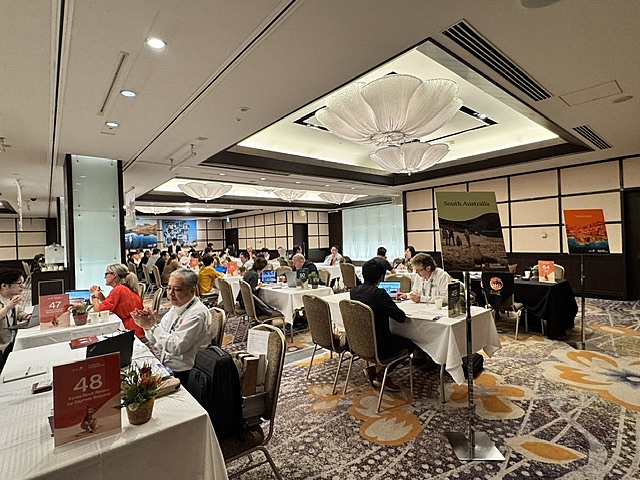 日本・韓国からのバイヤーがオーストラリアから来日したセラーと熱心な商談会を実施した
One of the focuses in ‘Tourism 2035’ is ‘Chosen by AI’
Under the 10-years ‘Tourism 2035’ strategy, TA aims to increase spending by high-yield travelers to as much as AUD 69 billion (approximately JPY 7.866 trillion) by 2035, with the gaol of making Australia the destination that every traveler dreams of first and ultimately chooses.
There are four key priorities. First, in addition to storytelling that connects with people, TA is implementing marketing strategies that ensure Australia is properly recognized and recommended as a travel destination by AI and search algorithms.
TA is adapting to an AI-driven marketing landscape. Baines revealed that a specialized team at headquarters is working on this initiative, ensuring their information is discovered and recognized by AI, which has become a critical challenge.
One of the concrete actions is the launch of a new Instagram account, ‘@australia.guides.’ While the main account, ‘@australia,’ focuses on the ‘Why’ inspiring the desire to travel, the new account specializes in the ‘How’ offering sample itineraries and specific travel plans.
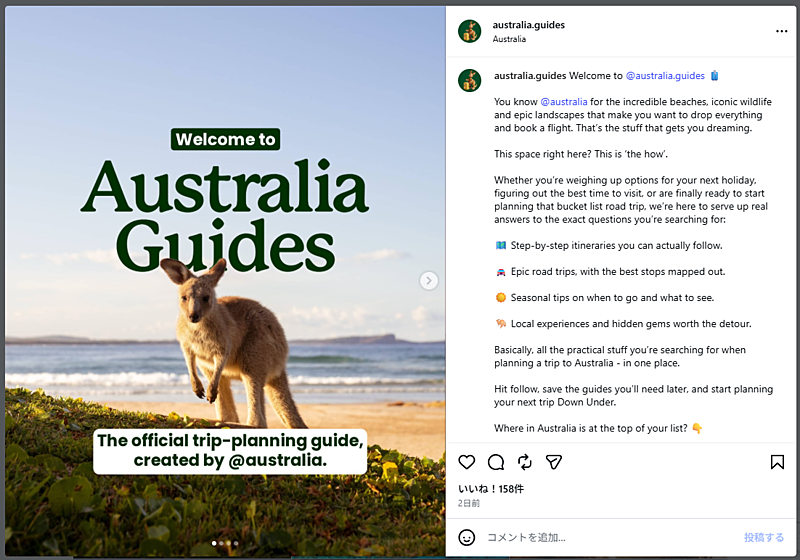 オーストラリア政府観光局のAIに対応するためのアカウント
O'Brien also explained that TA is providing education on AI adaptation to local tourism operators. She added that it is necessary to become ‘AI-ready,’meaning that the products should properly be recognized and displayed by AI, so that their products appear effectively in the places where travelers search for experiences, services, and products.
The second priority is to promote a diverse range of travel experiences, extending beyond beaches and wildlife to include food and wine, urban destinations, and Indigenous culture with a 65,000-year history.
The third one is to encourage travelers to venture beyond host cities and explore regional areas, leveraging major events like the Rugby World Cup.
The forth one is to showcase a unique Australian luxury travel on deep connections with nature and rare, meaningful experiences.