




Takahiro Ikeji, tourism finance lawyer and senior researcher of Japan Travel Bureau Foundation, explained what is going on an accommodation tax in Japan at the annual seminar of Japan Hospitality Asset Managers Association (HAMA Japan).
A flat rate may be more adopted
According to the Japan Tourism Agency, as of January 13, 2026, 19 local governments have introduced an accommodation tax, including Tokyo, Kyoto City, Osaka Prefecture, Kutchan Town, and Niseko Town. 39 local governments have already received approval from the Ministry of Internal Affairs and Communications. Miyagi Prefecture and Sendai City were the most recent to introduce the tax in January 2026. Okinawa Prefecture, which enacted a bylaw in September 2025, is aiming to introduce it during fiscal 2026.
The accommodation tax is literally a local tax (extra-statutory special-purpose tax) paid by guests. It is collected by accommodation facilities and remitted to the local government. The biggest difference is that local governments can decide whether to set it as a flat rate or a fixed rate.
Most local governments that currently implement accommodation taxes adopt a tiered flat rate system, in which a fixed tax is gradually levied on the accommodation fee. Kyoto City, for example, will review the flat tax system to five stages: 200 yen a night for 6000 yen or lower, 400 yen a night for 6000 yen to 20,000 yen, 1,000 yen a night for 20,000 yen to 50,000 yen, 4,000 yen a night for 50,000 yen to 100,000 yen and 10,000 yen a night for 100,000 yen or higher.
On the other hand, few local governments adopt a fixed rate system. In 2019, Kutchan Town became the first town in Japan to introduce a 2% accommodation tax on lodging fees. This is scheduled to change to 3% from April 1 2026. Okinawa Prefecture has decided to introduce a 2% flat rate system. Tokyo intends to switch from a flat rate system to a fixed rate system.
In fact, many accommodation operators are against a fixed rate system because the amount collected changes each time and administrative procedures become cumbersome. Ikeji, however, said, “In the future, a backyard IT system for a fixed rate will be more sophisticated, and even a flat rate will likely reduce the burden on businesses. Fixed rates are likely to become more common in the future, including through revisions.”
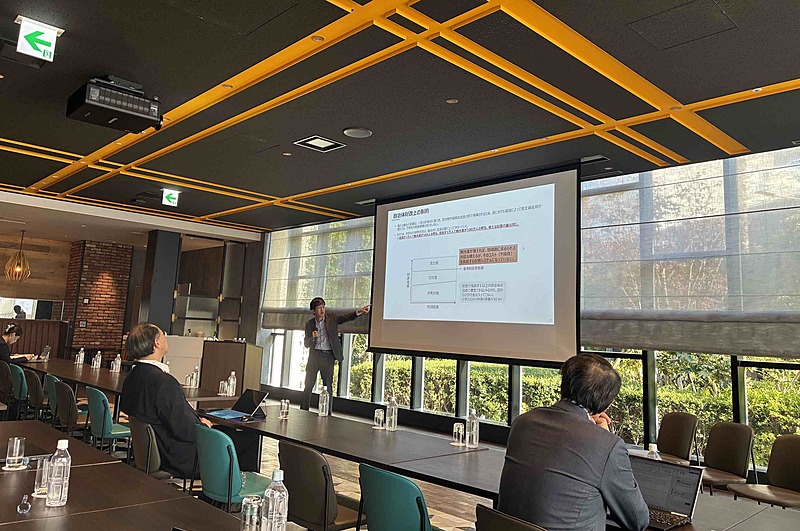 HAMA Japanのセミナーで宿泊税を解説する池知氏。
Accommodation tax will grow together with DMO
“How can a local government improve regional competitiveness ? How can a local government secure the necessary funds for that? These are the starting points for introducing a lodging tax,” Ikeji explained.” As a tourist dose not stay in a particular hotel or ryokan, but travel around the area, the point is what kind of budget should be used for development of a public area. “An accommodation tax depends on whether regional competitiveness should be regarded as a point or as an area.”
The local allocation tax system is designed to adjust for disparities in financial strength among municipalities, but it is premised on securing the necessary funding for administrative services for residents. Basically, a city’s or town's financial situation is determined by the number of residents, so the financial resources available to a town with 10,000 residents and 100 tourists are not significantly different from those of a town with 10,000 residents and 1 million tourists. If tourists increase, then burdens on a region increase, but there is no a finance system to cover those costs.
In the case of accommodation tax, the more tourists there are and the higher the prices, the more tax revenue there will be. Ikeji said, “The accommodation tax is a tax that has the potential to bounce back in proportion to the investment.”
The accommodation tax is a source of revenue for local governments. It does not need to be paid to the national government. Ikeji emphasized, “The important thing is how a local government uses it wisely.” For that, it is essential for a local government to develop tourism master plans and ordinances that define how accommodation tax revenue should be used, and strategically consider the future of their region.
Ikeji said, “The good point of an accommodation tax is that it encourages local communities to think seriously about tourism.”
To draw up a master plan for a region as a whole, participation not only accommodations, who are responsible for collecting the accommodation tax, but also a variety of local stakeholders. “Therefore, roles of a local DMO will be significant.,” Ikeji said. “An accommodation tax will grow together with a DMO.”