



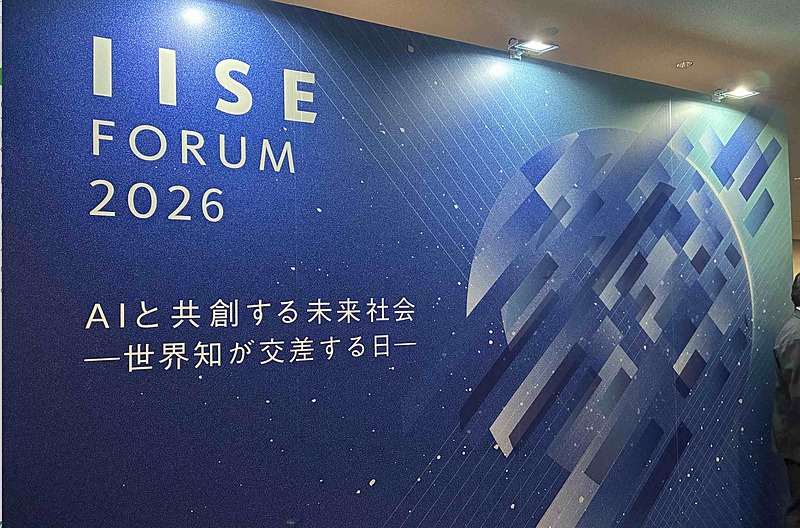
Institute for International Socio-Economic Studies (IISE), an independent think tank of the NEC, held a symposium ‘IISE FORUM 2026’ with a theme of ‘The future society created together by AI.’ In a breakout session about AI, Data and Self-Sovereign Identity,’ JAL, NEC and Ministry of Internal Affairs and Communications discussed Self-Sovereign Identity, which is expected to penetrate into the future society.
What is Self-Sovereign Identity?
Self-Sovereign Identity is to manage your own date by yourself, using Decentralized Identifier(DID)or Verifiable Credentials(VC). Kazue Sako, Waseda University professor, explained, “In today's society, each user has a separate ID for each service.The data you can access with that ID is limited to that specific domain.However, a self-sovereign identity allows you to have only one ID, and you can connect, control, and share the services and data you've received with that ID.You can log in, manage your accounts, and control your data in a self-centered way.”
It is true that there are many challenges for Self-Sovereign Identity, such as how you can identity yourself in the extended digital space or how much you can handle authority and responsibility in the AI world.
Yuji Shimoyama from Ministry of Internal Affairs and Communications said, “Our top priority is ensuring a safe and secure environment without hindering technological development,” referring to the administrative initiative to regulate catfish in virtual space.
Professor Sako talked about security in the digital space, showing her idea that it can be supported by new encryption technologies and introducing ‘open key cryptography,’ which encrypts and decrypts data using two different keys of a public key and a private key, and one of them, digital signature.
In addition, she mentioned ‘selective disclosure’ and said,”Previously, it was a binary choice: either show all information or hide it. Now, you can select and disclose only the necessary information and prove its legitimacy.”
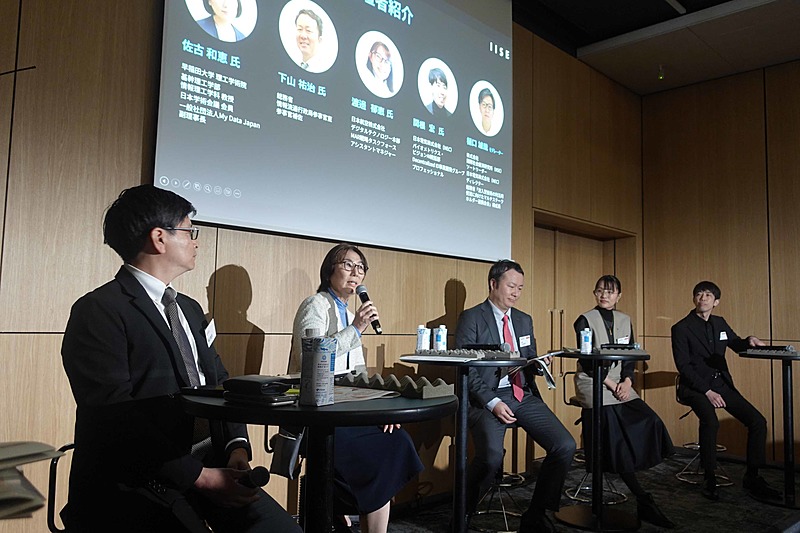 (From left)Moderator IISE Higuchi、Waseda University Sako、Ministry of Cmmunications Shimoyama、JAL Watanabe、NEC Skine
What can be done with Self-Sovereign Identity?
Ikue Watanabe from JAL explained the JAL’s actions toward Self-Sovereign Identity. Referring to digital passport that major airlines and IATA focus on today, “Various social challenges can be solved by using digitized passports and visas in passenger procedures and airport experiences.”
She added that Self-Sovereign Identity will possibly solve shortage of labors and raise operation efficiency.
Japan has an advantage in the face recognition procedures at Haneda Airport or Narita Airport, while Europe is far going ahead in utilization of Self-Sovereign Identity on smartphone, according to Watanabe. She said, “It is necessary to make use-cases to penetrating Self-Sovereign Identity into the society.”
Hiroshi Sekine from NEC said, “With self-sovereign identity, your data accumulate across various economic spheres in your daily life because you own your own data. If you present that data to companies, you will receive even better services.”
Referring to the travel space, where a traveler moves from an airport to a destination and does something there, he said, “ The industry-cross efforts will raise values of Self-Sovereign Identity.”
JAL’s Watanabe emphasized how Self-Sovereign Identity can improve user’s convenience, saying, “With the ability to securely provide personal information in the form of VC when purchasing airline tickets, it will become possible to purchase tickets with a single click without having to enter information one by one.”
What is needed for social implementation?
Shimoyama from Ministry of Internal Affairs and Communications explained that the government supports technology development to find fake information together with private sectors. He added, “The authenticity of information is a challenge that carries unexpected risks for businesses, local governments, and others. We are tackling with the challenge as a whole society.”
Watanabe from JAL said that its is important to make rules and gather industry friends for Self-Sovereign Identity. She added, “From the perspective of using data beyond a particular economic zone, Self-Sovereign Identity is not an effort by one entity.”
Sekine from NEC agreed with Watanabe, saying that a perspective of empathy of consumers, not company’s benefits, will be required.”
In addition, professor Sako suggested to use ‘My Number Card,’ a Japan’s national ID system, as VC. She said, “If the existing infrastructure can be used, VC will possibly penetrate into the society faster than expected.”