



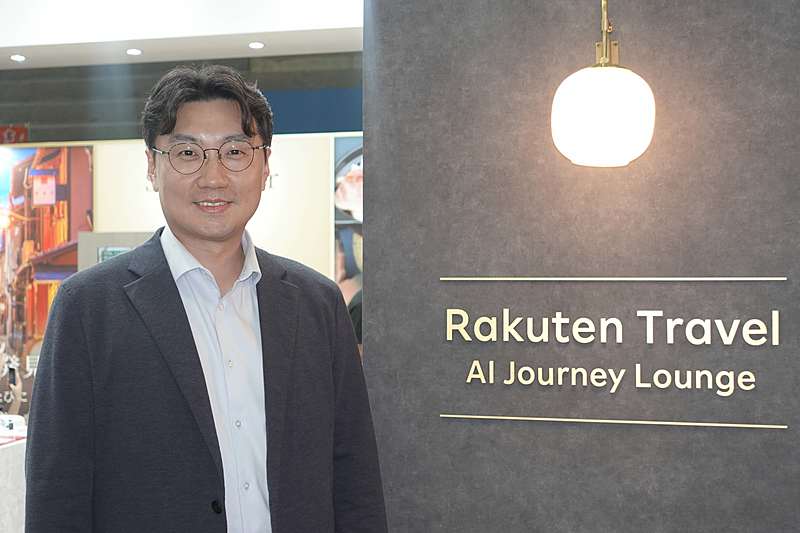
Rakuten Travel Xchange, one of the Rakuten Group, is in charge of distributing the world’s hotel inventories through global OTAs and whole sellers as well as Rakuten Travel and Rakuten STAY inventories in Japan. Rakuten Travel Xchange CEO James Park talked about its innovative B2B distribution as a travel tech company and also the recent travel trends from the business perspective.
Three business sectors
Based in Singapore, Rakuten Travel Xchange’s primary role is to distribute travel-related inventory—such as accommodations—to the global market. It sources inventory from a wide range of providers, including major OTAs, regional destination management companies (DMCs) and local businesses, with a core focus on hotel inventory from Rakuten Travel and vacation rentals from Rakuten STAY.
In the beginning, its operations consisted primarily of distributing Rakuten’s Japanese inventory globally. “Nowadays, the revenue structure has since evolved,” Park said. “Half of our revenue comes from selling Rakuten Travel’s inventory, sourced from Japan and East Asia, to travel agencies worldwide. The other half is generated by selling inventory sourced from other suppliers, often in combination.”
Rakuten Travel Xchange deals with more than 500,000 accommodations and more than 200,000 vacation rentals, out of which direct contracts reached about 20,000 hotels and vacation rentals. It currently distributes its inventories to about 200 countries.
The biggest business is distribution to travel companies in the world through API. Park said that the strengths are flexible API designs to meet clients’ needs, speed to a market, response speed and flexibility.
The second business pillar is the ‘Travel Agent Portal.’ This online portal is designed primarily for small-scale travel agencies. It not only provides access to global inventory but also streamlines operations by rapidly delivering the information travel agencies require.
The third business pillar is the ‘Custom Website.’ It is a white-label service in which Rakuten Travel Xchange provides the website infrastructure to sales partners, helping them sell Rakuten Travel Xchange’s inventories under their own logos and domain names.
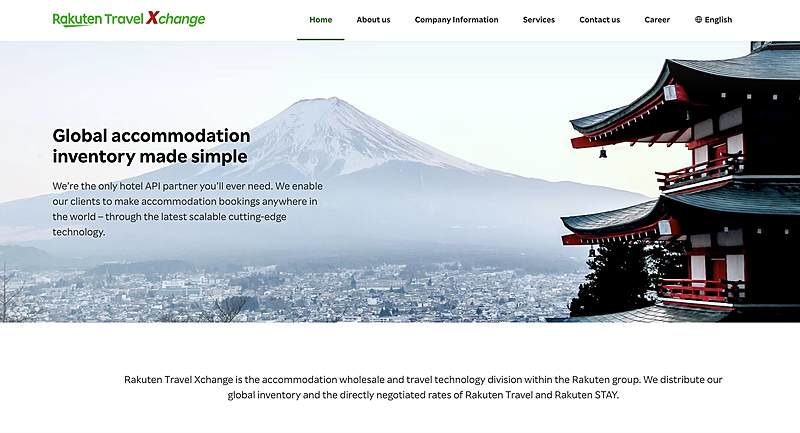 Rakuten Travel Xchangeのウェブサイト
To compete with rivals
Park emphasized the Rakuten Travel Xchange’s business strengths: “I believe the true strength lies in the ability to attract customers independently and manage contracts with hotels directly. In this sense, Rakuten has a large number of direct contracts with accommodations and obtains their trusts.”
The direct relationships allow Rakuten Travel Xchange to negotiate dealings with them and solve a problem by itself if it happens. Also, for large-scale campaigns, Rakuten Travel Xchange can encourage accommodation providers to offer more competitive rates or added value. Park said, "These points are crucial.”
He cited the ability to consolidate content onto a single platform and then convert and deploy it in formats easily resold on various platforms. Park said with confidence, "We achieve this by combining the use of an AI platform with Rakuten's brand power.”
In addition, he highlighted the synergy within the "Rakuten Ecosystem" as a unique advantage over competitors. “For instance, we can gain insights into payment behavior from Rakuten Card and understand trends in people's mobility and data usage from Rakuten Mobile. We sometimes generate synergies between business units, connecting users acquired in one area to another,” he said. “This is the biggest advantage for us as the Rakuten Group.”
The travel industry has been changing globally. There are more B2B travel companies that provide travel booking platforms, often as white-label services, to businesses in other sectors, such as credit card companies and mobility firms. “"Travel is no longer something sold exclusively by travel agencies. It is evolving into something more accessible and easier for businesses across all industries to incorporate, much like everyday consumer goods or e-commerce,” Park said. “Rakuten Travel Xchange aims to provide such solutions and create an environment where people around the world can enjoy travel more easily and conveniently.”
While Rakuten Travel Xchange has already established a solid foundation in the Japanese market, Park noted the presence of strong competitors in other regions, such as South Korea, Taiwan, and Malaysia. It intends to establish a firm position in the Asian market.
 プライベートでも何度も日本を訪れているパク氏。今度は東北を旅してみたいと話す
Inbound travel trends seen from data
In the recent inbound travel market of Japan, Chinese visitors have largely decreased, while visitors from long-haul source markets have increased. Park sees that the total spending in the market may increase in 2026 because visitors from Europe, US or Australia stay longer.
Highlighting a year-on-year increase of approximately 80% in the Gross Merchandise Value (GMV) of luxury hotels, Park said, "Rakuten Travel Xchange is currently focusing on that segment as well.”
Park also mentioned ryokan as a Japanese unique accommodation. “As a distributor dealing with Japanese inventory, Rakuten Travel Xchange understands what is most important for enjoying the ryokan experience and takes pride in being an expert in this market,” he said. “We intends to support the global sales of ryokans by leveraging AI tools.”
AI strategy of Rakuten Travel Xchange
As a company that is both a distributor and a technology firm, Rakuten Travel Xchange prioritize AI as a business strategy. Park picked multi-languages translation by AI as one of the examples. Selling Japanese accommodations to overseas markets requires translating complicated room and plan names from Japanese into other languages.
Rakuten Travel Xchange has integrated "Rakuten AI" into its operations.The system goes beyond simple mechanical translation, using AI to assess the relative importance of information. Park revealed that this approach has reduced the time required for accurate translation by 90%.
As a second example, he cited "hotel mapping" (the consolidation of hotel data), a key challenge within the B2B distribution market. Unless wholesalers consolidate information from various providers and treat a property as a single entity, the same hotel may appear as duplicated listings to customers. Park said that AI is being employed to address this issue as well.
The hotel mapping is evolving to ‘room mapping (the consolidation of room data). As machines cannot easily distinguish room variations, machine learning is required. Park revealed that Rakuten Travel Xchange is developing its original AI capable of identifying which rooms are identical and which are fundamentally different.
“Rakuten Travel Xchange’s mission is to efficiently provide services to its travel and industry partners,” Park said. “For the mission, AI plays a big role.”