



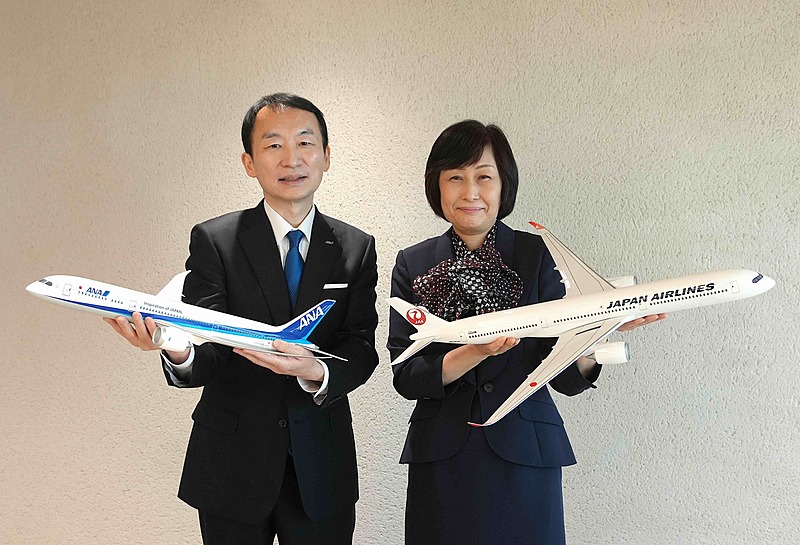
ANA and JAL released the second edition of their joint report, ‘Toward Net Zero CO2 Emissions from Air Transport in 2050,’ outlining the current state of sustainable aviation fuel (SAF) in Japan and the actions needed to support aviation decarbonization. The report calls for a society-wide effort to achieve net-zero carbon dioxide emissions in air transportation by 2050.
In this report, they position SAF is now at a stage where solutions are being sought to address global fuel production shortages and manufacturing costs that are several times higher than conventional aviation fuels, moving beyond the "awareness and education" stage.
The report warns that without increased SAF production and cost reductions within the next five years, the aviation industry will be unable to meet its emissions goals without significant social and economic impact.
The report also says that stable fuel supplies are critical to supporting the goal of attracting 60 million inbound visitors and maintaining air service to regional communities and remote islands that rely on aviation as essential infrastructure.
ANA and JAL recognize that a tailored Japanese model that balances the pace of SAF regulation with actual domestic SAF production capacity should be built.
In addition, ANA and JAL are promoting a "Co-creation Model" in which the high costs of SAF implementation are supported collectively by society as a whole through corporate programs that contribute to reducing customers' Scope 3 emissions.